Home › News › GR20 closed between Tighjettu and Ciottulu di i Mori — Albertacce fire, Ballone evacuated
GR20 closed between Tighjettu and Ciottulu di i Mori — Albertacce fire, Ballone evacuated
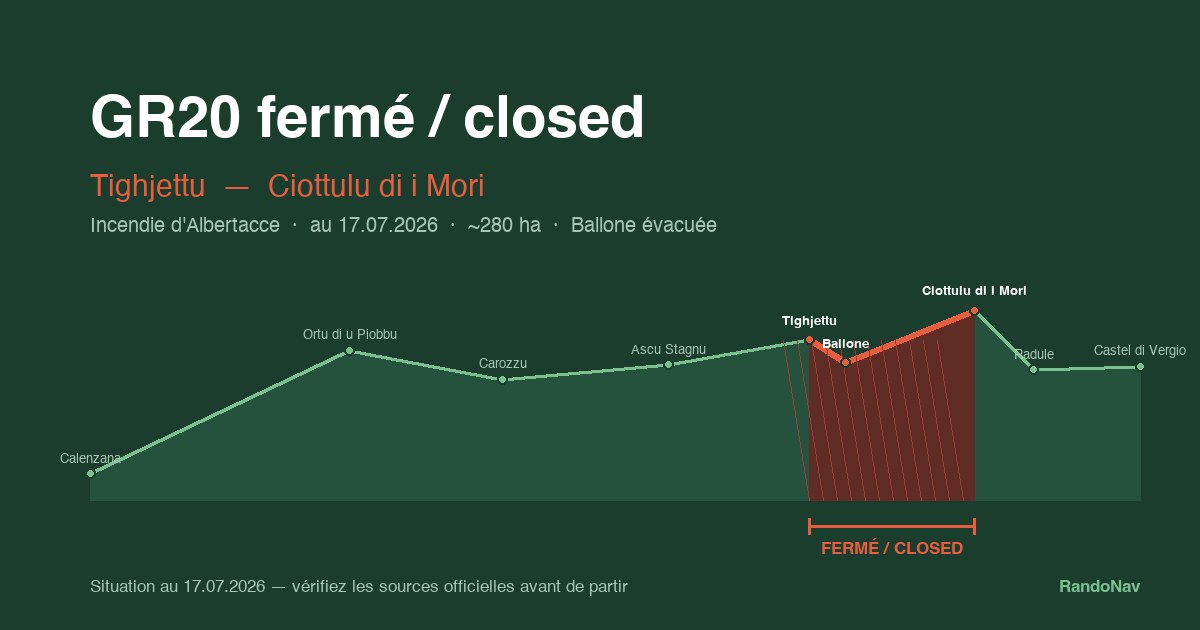
This is a fast-moving situation. Check the official channels before you set off, not this page.
A fire started by lightning strikes in the heights above Albertacce (Haute-Corse) has been burning since 10 July and, as of 17 July, has run through roughly 280 hectares. As a safety measure, authorities have closed the GR20 in both directions between the Refuge de Tighjettu and the Refuge Ciottulu di i Mori. The stretch between Ciottulu di i Mori and Asco has also been declared off-limits to walkers.
What has happened
The Bergerie de Ballone was evacuated, with around twenty people brought out. The wardens of the Refuge de Tighjettu were evacuated by road. Roughly 120 personnel are working the Albertacce fire, with a further 40 on a separate fire near Corte, and reinforcements were expected from the mainland.
The terrain is what makes this hard to fight: the flames are moving across rocky crests, pine forest and dense vegetation in a zone that vehicles simply cannot reach, which is why so much of the effort has been airborne — water bombers and helicopters. The weather has not helped either, with winds around 50 km/h, temperatures above 30 °C and humidity under 30%. Conditions were reported to be turning more favourable on the evening of 14 July, but the fire remained active.
If your plan crosses this section
This is the classic northern section — the one most walkers doing the full crossing pass through in their first week — so a lot of plans are affected.
Do not try to walk around it. A closure on a fire like this exists so that hikers are not in the way of aircraft and ground crews, and so that nobody gets caught by a front that can move faster than you can walk. Improvising a detour through the maquis in these conditions is exactly how people get hurt.
Check the official sources first. The Parc naturel régional de Corse and the Haute-Corse prefecture are the authorities on when the trail reopens — not us, and not a Facebook thread.
If you had a booking at Tighjettu, Ballone or Ciottulu di i Mori in the coming days, contact them directly. Reservations for PNRC refuges go through pnr-resa.corsica; the Bergerie de Ballone is privately run and books separately.
If you're mid-trek, Asco (Ascu Stagnu) and Castel di Vergio both have road access, which makes them the practical points to wait it out or to leave and rejoin the trail further along.
We will update this post as the situation develops. Corsica burns most summers, and fires around the GR20 corridor are not rare — but a closure of this length in peak season is worth taking seriously.
Plan your own GR20
Set your pace, see live refuge availability, offline maps and a daily weather briefing — free.
Open the GR20 plannerSources
- france3-regions.franceinfo.fr/corse/haute-corse/haute-corse-incendie-en-cours-a-albertacce-dans-le-secteur-du-gr20-3386434.html
- www.corsenetinfos.corsica/Albertacce-Le-feu-de-depasse-la-centaine-d-hectares-le-refuge-de-Ballone-evacue-et-le-GR20-ferme_a91699.html
- www.corsenetinfos.corsica/Les-incendies-restent-actifs-en-Haute-Corse-115-agents-mobilises-des-renforts-attendus-du-continent_a91705.html
- www.ici.fr/corse/feux-de-foret-en-haute-corse-165-hectares-parcourus-une-partie-du-gr20-et-plusieurs-acces-fermes-1505168
- www.alta-frequenza.corsica/actu/albertacce_l_incendie_atteint_la_centaine_d_hectares_detruits_un_refuge_evacue_129128
- www.corsenetinfos.corsica/Incendies-la-lutte-se-poursuit-a-Albertacce-et-Corte-Restonica_a91746.html
- www.corsenetinfos.corsica/Incendies-en-Haute-Corse-Le-feu-fixe-a-Albertacce-plusieurs-foyers-toujours-actifs-a-Corte_a91853.html
- france3-regions.franceinfo.fr/corse/haute-corse/incendies-en-haute-corse-le-feu-d-albertacce-fixe-mais-sous-surveillance-300-hectares-brules-3390691.html